Voltar ao Caderno
Gastronomy
Honey in mixology: when the blossom becomes part of the recipe
Different flowerings, new combinations, and drinks with identity.
5 min read
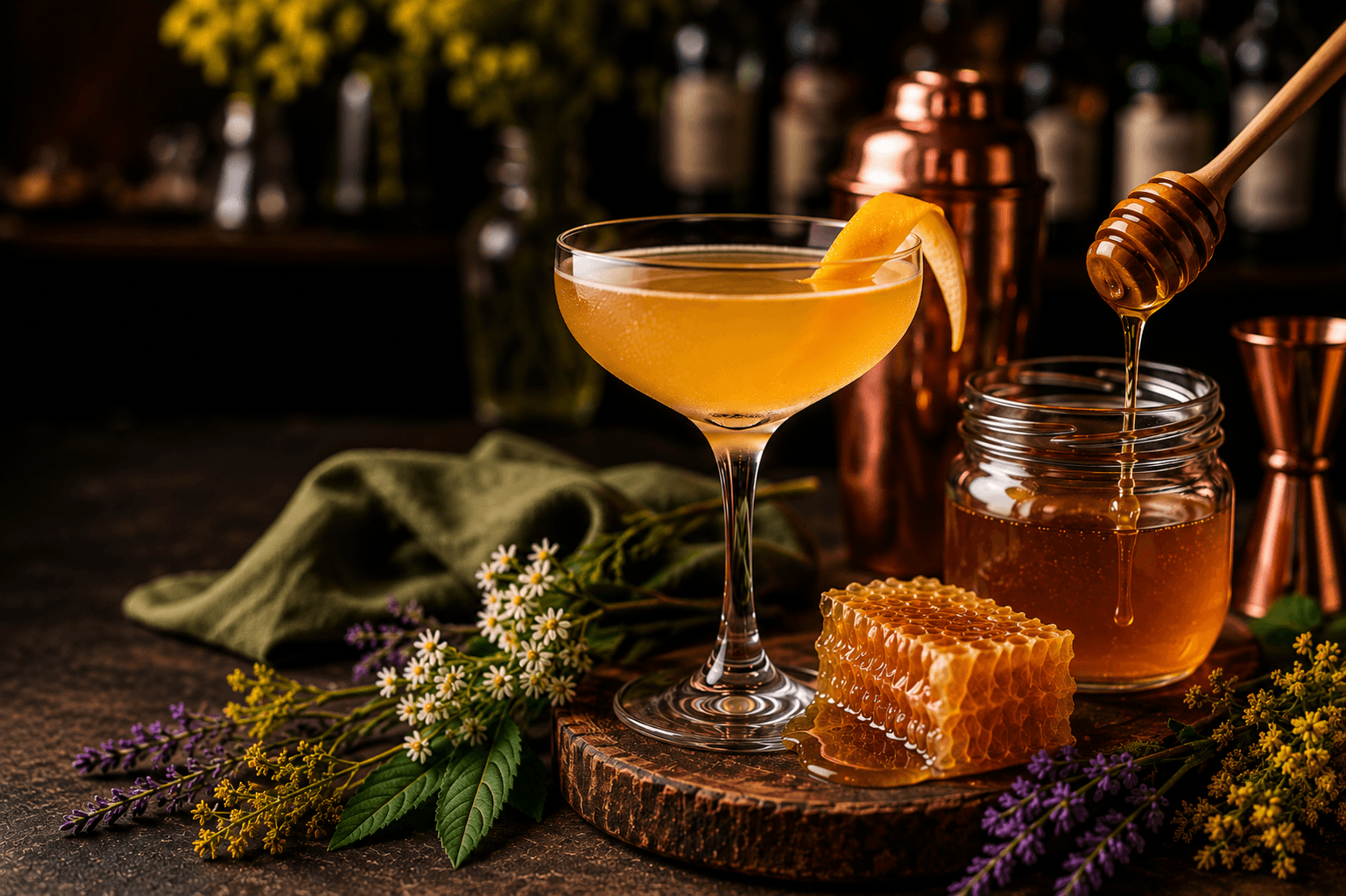
More than just replacing sugar, different honeys can add aroma, texture, and identity to cocktails — opening a field of experimentation for bartenders and mixologists.
For a long time, sweetening a cocktail meant relying mainly on sugar or the traditional simple syrup, prepared with sugar and water. It does its job well: it balances acidity and bitterness and contributes to the drink's texture.
Honey, however, can do something more.
Unlike refined sugar, which has a relatively neutral aromatic profile, honey carries characteristics related to its botanical origin. Aroma, flavor, intensity, and color can vary according to the plants that provided nectar to the bees.
For mixology, this opens up an interesting possibility. The question is no longer just:
“Can we replace sugar with honey?”
And becomes:
“Which honey pairs best with this cocktail?”
Honey is already in great cocktails
The use of honey behind the bar is nothing new.
The Bee’s Knees, a classic associated with the Prohibition era in the United States, combines gin, lemon, and honey. The Gold Rush features bourbon, lemon, and honey. Meanwhile, the Penicillin, one of the great modern classics of mixology, brings together Scotch whisky, lemon, ginger, and honey.
These cocktails demonstrate that honey can perform more than one function: sweeten, contribute to the texture, and participate in the aromatic construction of the drink.
But there is a next step that deserves to be explored.
Instead of simply specifying “honey” in the recipe, why not ask which honey?
Not all honey is equal
For a bartender, understanding different floral sources can become just as interesting as knowing styles of spirits, bitters, coffees, teas, herbs, or fruit varieties.
A delicate and floral honey does not show the same sensory behavior as one that is more intense, woody, or longer-lasting on the palate.
This difference allows honey to be thought of as part of the pairing.
A more delicate profile can find its place in compositions with gin, vodka, sparkling wine, or white rum. More intense honeys can open up possibilities with bourbon, whisky, aged rum, or cachaças.
These are not rules. They are starting points for sensory experimentation.
In mixology, the result depends on the whole: spirit, acidity, bitterness, fruits, botanicals, spices, temperature, and dilution also modify the final perception.
This is precisely why experimenting with different floral sources can be so interesting.
From the Caatinga to the bar counter
The diversity of the Caatinga allows this discussion to be brought into an even more specific territory.
Quipé, cassutinga, caatinga-de-cheiro, algaroba with juazeiro, malva-branca, and aroeira-do-sertão can yield honeys with distinct sensory characteristics.
For a bartender or mixologist, this means working not only on the relationship between honey and spirit, but a broader equation:
floral source + spirit + acidity + bitterness + botanicals + fruits + spices.
It is even possible to reverse the traditional creation process.
Instead of developing the cocktail first and choosing the sweetening ingredient later, the bartender can start with the honey itself.
Taste it. Identify aromas, intensity, sweetness, texture, and persistence. Then select the ingredients capable of dialoguing with that profile.
In this process, the floral source stops being just information about the product's origin and becomes part of the drink's creation itself.
Can a Bee’s Knees transform six times?
Perhaps one of the best ways to understand this possibility is through a simple experiment.
Prepare a Bee’s Knees using the same recipe, the same gin, the same lemon, the same ice, and the same technique.
Change only one variable: the honey.
Make a version with quipé. Then cassutinga. Caatinga-de-cheiro. Algaroba with juazeiro. Malva-branca. Aroeira-do-sertão.
Structurally, the cocktail is still a Bee’s Knees.
Sensorially, will it be the same drink?
That is the experiment.
The comparison allows us to observe how much of the identity of each honey remains perceptible after its incorporation into the cocktail and how each floral source interacts with the gin and the acidity of the lemon.
For a bar professional, it ceases to be just a recipe and becomes an exercise in sensory analysis.
How to work with honey in the bar
There is an important technical issue: due to its viscosity, pure honey can be difficult to incorporate directly into a cold drink.
A traditional solution in mixology is honey syrup, obtained by diluting honey in water. The result is more fluid and easier to integrate with the other ingredients.
The concentration can vary according to the recipe and the desired result. The important thing, when working with mono-floral honeys, is to consider that dilution also interferes with the sensory intensity.
If the intention is to perceive the differences between the honeys, all other parameters must remain controlled.
It is also advisable to avoid unnecessarily high heating. If the goal is to explore aroma and flavor, it makes sense to prepare the syrup carefully, using only the heat necessary to facilitate mixing.
From sweetener to ingredient
Contemporary mixology already explores ingredients such as infusions, ferments, bitters, coffees, teas, herbs, spices, and botanicals to build identity.
Honey can occupy this same territory.
With one particularly interesting difference: its story begins before the bar.
Before the glass, there is a floral source. There is a plant. There are bees traveling a territory in search of nectar.
In the Caatinga, where rain and drought profoundly transform the landscape and determine different flowering cycles, this relationship becomes even more evident.
Knowing the origin of the honey therefore adds a new variable to the bartender's creative process.
Not just how much honey to use.
But which floral source to choose.
An invitation to experimentation
The exercise can start in a simple way.
Choose a cocktail that uses sugar or simple syrup. Prepare a reference version and, then, versions using syrups produced separately with different honeys.
Keep the other ingredients, proportions, and techniques identical.
Compare aroma, sweetness, body, integration with the spirit, persistence, and finish.
Then try the reverse path: choose the floral source first and create a cocktail for it.
It is at this moment that honey stops being just an alternative to sugar.
It becomes a creative ingredient.
And a particularly interesting territory emerges between mixology and single-origin honey: two universes united by botany, aroma, territory, and flavor.
From the blossom to the glass.